
"By the time you see the brown stains, a bacterial biofilm is already established in the tear duct. That's why wiping never ends it. You're fighting it from the wrong side."
— Dr. Claire Bennett, DVM

April 15, 2026 at 10:42 am EDT
by Dr. Claire Bennett, DVM
Lily's face was supposed to stay white. I failed her for three years.
If you've been told tear stains are "just cosmetic"...
If your vet says "some breeds just do that"...
If you've tried wipes, filtered water, food changes, and supplements only to watch the stains come back...
If you've stopped taking photos with your dog because the brown streaks always ruin them...
You need to hear what I discovered.
Because what the research shows about tear stains could finally end the cycle you've been stuck in.
Here's the shocking truth: the bacteria causing your dog's tear stains form a protective shield biologically designed to survive every cleaning method you've tried.
In fact, research cited by the National Health and Medical Research Council shows that biofilms are involved in roughly 65–80% of microbial and chronic infections.
Most owners think tear stains are a grooming issue.
Most vets treat them as cosmetic.
But this isn't about grooming. This isn't about genetics. And it's definitely not about your dog "just being that kind of breed."
This is about a bacterial colony inside your dog's tear ducts that regenerates faster than you can wipe it away.
And understanding what it is will change how you see every product you've ever tried.
The Day My Tear Stain Knowledge Failed Me Completely

I'm Dr. Claire Bennett, DVM, and I've practiced small-animal veterinary medicine for 14 years.
I graduated from the University of Sydney School of Veterinary Science, and I've treated over 6,000 dogs with chronic tear staining.
I also thought I understood tear stains completely.
Then I brought home Lily.
Lily was a Maltese puppy. Pure white. The kind of face people stop on the street to admire.
When the first brown streak appeared at six months, I did exactly what I'd trained to do:
filtered water, diet change, tear stain wipe, reassure the owner (myself).
"It's just cosmetic," I told my husband.
"Some breeds just get them."
I was dead wrong.
Over the next three years, I tried every supplement on the pet store shelf.
Every wipe.
Three different diets.
Distilled water, filtered water, stainless steel bowls.
Each time, the stains came back within days.
By Lily's third birthday, I had a folder on my phone of photos I couldn't share.
The stains weren't just cosmetic. They were affecting how she looked, how strangers reacted to her, and how I felt every time I tried to take a picture.
I had every tool modern veterinary medicine offered. I had failed my own dog with everything I'd been taught.
The Investigation That Shattered 14 Years of Veterinary Training

That night, I couldn't sleep.
How does a healthy dog on filtered water, premium food, and three different supplements still end up with stains that won't clear?
I started digging through medical microbiology journals. Not pet supplement research. The actual bacteriology literature.
What I found changed everything I thought I knew about tear stains.
The research revealed something most vets are never taught:
Tear stains aren't a grooming problem. They're the visible symptom of a bacterial colony that has built itself a protective shield inside your dog's tear ducts.
Here's the mechanism no pet store supplement addresses:
When a dog's tear film breaks down, tears evaporate too fast, and the eye compensates by overproducing. That constant overflow creates a permanently moist environment.
Opportunistic bacteria colonize that environment.
Then they do something most owners have never heard of:
Over time, this buildup begins to protect itself – making it harder to fully remove with simple wiping.
Once this biofilm forms, bacteria can become up to 1,000 times more resistant to treatment.
This biofilm produces porphyrin, the reddish-brown pigment you see staining your dog's fur.
You wipe the porphyrin off the fur. The biofilm produces more. Faster than you can clean it.
The stains aren't the disease. They're the exhaust.
The engine is the biofilm, and it's inside the tear duct where no wipe can reach it.
Every traditional treatment fails because we're cleaning the symptom while the root cause keeps producing.
Why Every "Solution" You've Tried Makes It Worse

Armed with this understanding, I looked at every conventional approach differently:
Eye wipes and cleansers?
Remove surface porphyrin. Don't touch the biofilm.
Result: stains return within hours because the biofilm is still producing.
Grooming and trimming?
Removes stained fur. Doesn't change tear chemistry.
Result: new fur grows in and gets stained all over again.
Filtered or distilled water?
Helps if minerals were a contributing factor. Doesn't disturb established biofilm.
Result: marginal improvement, then the stains come back.
Diet changes?
Can reduce allergic tearing. Doesn't address biofilm.
Result: temporary stabilization followed by return.
Most tear stain supplements on pet store shelves?
Rely on mild herbal ingredients. Can't penetrate a biofilm matrix.
Result: work for mild cases, fail on anything chronic. This is why product
reviews split in half: "worked great" next to "did nothing."
Then I discovered what most vets never learn about:
There used to be one tear stain product that actually worked. And in 2014, the TGA pulled it off the shelves.

Now, there was a common supplement for dogs on the market that actually worked for years.
The reason it worked was simple: it contained tylosin tartrate, a real antibiotic strong enough to disrupt the bacterial colony and interfere with biofilm formation.
Owners loved it. Forums were full of before-and-after photos. Stains cleared in weeks.
Then, on August 28, 2014, the TGA issued warning letters to three manufacturers selling tylosin-containing tear stain products. The charge: marketing an unapproved animal drug as a cosmetic supplement.
For over a decade, there's been no real replacement.
Owners have cycled through herbal supplement after herbal supplement, hoping one would finally work. Most don't. The few that help often stop working after weeks, because the underlying biofilm is still there.
What I worked toward was a different approach altogether – not a drug, and not another mild herbal blend.
A formula aimed at the conditions underneath the staining: the tear film, the eye's natural defenses, and the biofilm structure itself. It's not a stronger version of what's on the shelf.
It's a different target altogether.
This isn't experimental.
The compounds I'll show you next have been used in human medicine for decades.
For years, no one formulated them for dogs. When I finally found a formula that did, I knew this was what I'd been looking for.
The Three Compounds That Do What Tylosin Did

The breakthrough for me was what medical microbiologists already knew.
When humans fight biofilm-based infections, they don't just use antibiotics.
They use specific compounds that disrupt the biofilm matrix itself.
That's when I realized: tear stain supplements never use biofilm-disruption compounds. They use general antioxidants and herbs.
It targets the shield, starves the bacteria, restores the tear film.
For decades, pet supplement brands ignored it. Because no one understood biofilms were the issue. Until I found the protocol.
Three compounds. Three mechanisms.

N-Acetylcysteine (NAC) – breaks the disulfide bonds holding the biofilm matrix together. [STAT/STUDY NEEDED: NAC biofilm-disruption peer-reviewed citation]
Lactoferrin (150 mg) – binds the iron bacteria need to reproduce. 10–15x the dose of colostrum-based competitors. [STAT/STUDY NEEDED: Lactoferrin tear film antimicrobial function citation]
Omega-3 EPA/DHA (200 mg) – rebuilds the tear film so the cycle can't restart. [STAT/STUDY NEEDED: Omega-3 tear film stability research]
Introducing VisiPaw

I formulated it for Lily.
Then for my patients. Then for everyone who'd tried everything else and given up.
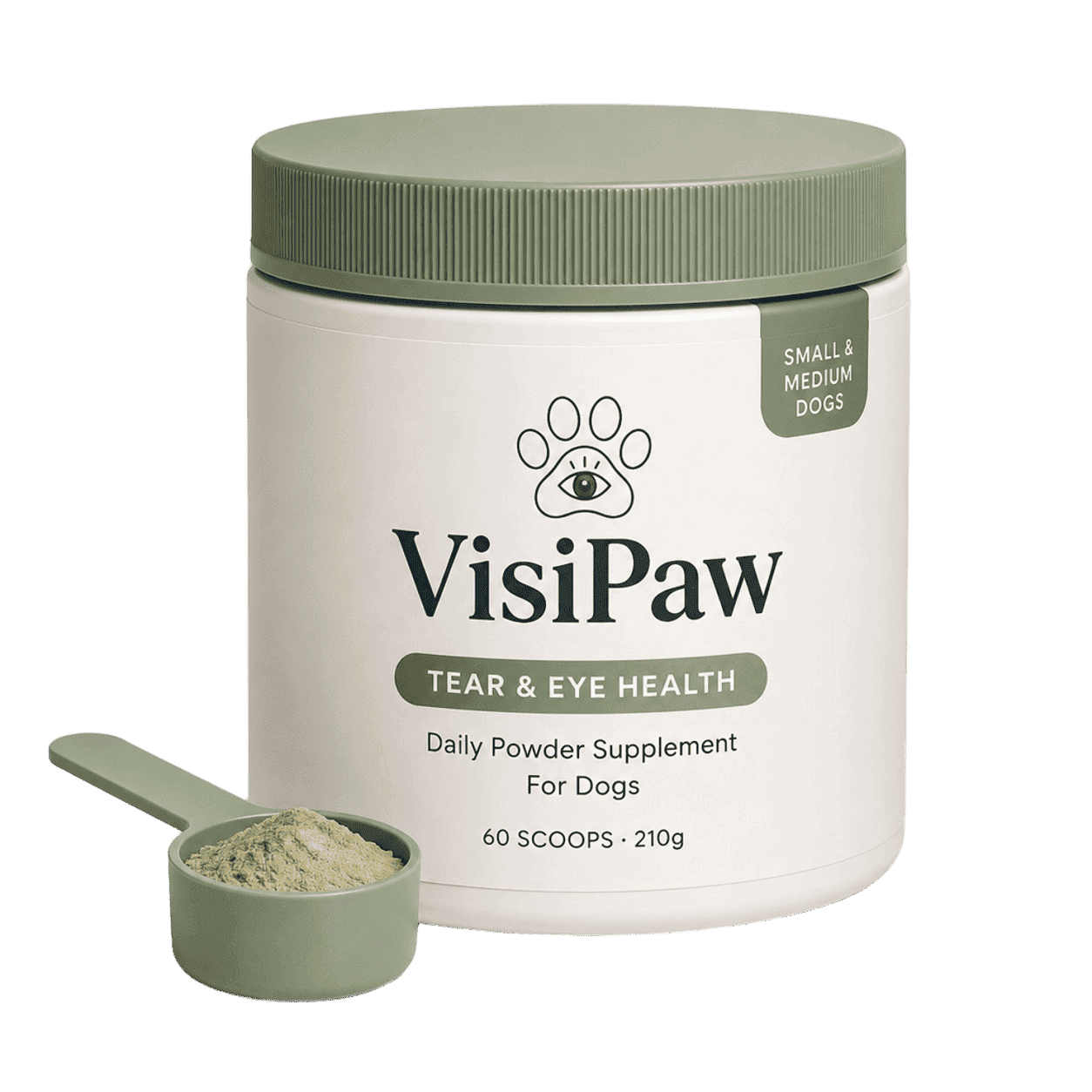
It's called VisiPaw. A daily powder. One scoop into the food. That's it.
No pills to hide. No chews picky dogs refuse.
Every serving delivers biofilm-disrupting NAC, 150 mg of standardized lactoferrin isolate, and 200 mg of microencapsulated wild Alaskan omega-3 – plus a full vision-protection complex for long-term eye health.
Dog-specific formulation. GMP-manufactured. Third-party tested.

Your Dog's Clean Face, Or Your Money Back
Here's the deal: I'm so confident VisiPaw will end the cycle for your dog that it's backed by a full 90-day money-back guarantee.
Try VisiPaw for 90 days. If you don't see the discharge thin, the tearing reduce, and new unstained fur growing in, send back what's left for a full refund. No forms, no questions.
Right now, first-time customers get:
60% off the buy 2 get 1 FREE bundle (covers the full biofilm-reversal window)
Free priority shipping on all orders
90-day money-back guarantee
24/7 customer support
Smart buyers choose the 3-jar bundle because biofilm reversal takes 8–12 weeks. A single jar runs out before the transformation is complete.
60% off. Free priority shipping. 90-day guarantee.
Smart buyers choose the 3-jar bundle because biofilm reversal takes 8–12 weeks. A single jar runs out before the transformation is complete. Only 127 jars remaining at this pricing.
See What Pet Parents Are Saying
Sarah L. · I was beyond skeptical. Nine weeks in and my Maltese has new white fur growing in at the base of the stained area. Finally starting to believe. 👍 12
Michael R. · The TGA/Angels Eyes story convinced me. I'd been buying the "natural" version for two years and knew something was different. Now it makes sense. Week 8 and tearing is way down. 👍 8
Anna C. · Week 6 and morning discharge is 80% gone. My poodle used to wake up crusty every day. Now I go days without cleaning. Worth it for that alone. 👍 15
Linda P. · My vet told me tear stains were "cosmetic" for five years. I knew they weren't. Month 3 of VisiPaw and I was right all along. 👍 11